
The Lossy Handoff: Rethinking How Figma Becomes Code
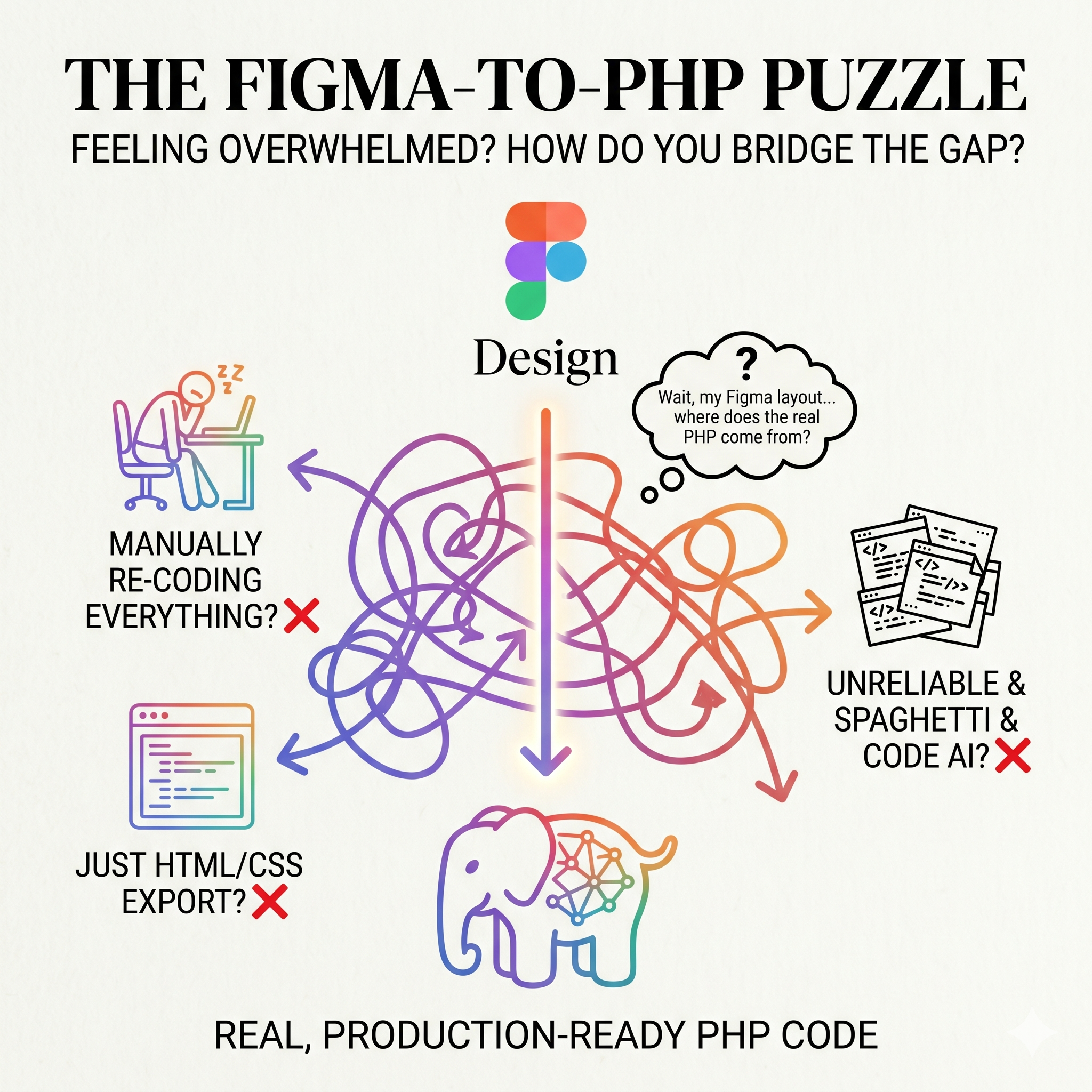
For as long as modern web development has existed, the transition from design to deployment has been a game of telephone. A designer creates a masterpiece. A developer interprets it. In the middle, variables are dropped, layouts are compromised, and hours of unbillable time are spent tweaking paddings in a browser inspector window.
We've accepted this friction as a natural law of software creation. But it shouldn't be.
When we started architecting the new Figma integration for Craftly.build, we wanted to address this fundamental problem from first principles. A design file shouldn't be a visual suggestion; it should be an explicit layout configuration.
Shifting the Paradigm: What Works Today
We built our integration to treat Figma as the absolute source of truth for your application's presentation layer. It works cleanly, securely, and end-to-end:
- Deterministic Design System Extraction: We don't guess your branding. Through a secure, per-user OAuth handshake, Craftly extracts exact hex codes, font families (mapping them natively to Google Fonts), line-heights, and layout directions directly from your Auto-Layout parameters.
- Semantic Section Discovery: Instead of spitting out an infinite wall of nested elements, the system reads the structural intent of your canvas. It organises code cleanly into logical blocks — heroes, features, pricing models — following proper component patterns.
- Vision-Guided Refinement: By introducing visual models into the pipeline, the AI "sees" the composition the way a human designer would, ensuring spatial relationships and hierarchy remain native to the code.
The result is a production-ready WordPress or Laravel environment running a live, interactive preview in seconds.
The Engineering Horizon: Our Roadmap
While the core extraction engine is fully operational and battle-tested today, our long-term perspective on this problem goes a step further. We are actively designing a self-correcting visual fidelity loop.
Instead of relying solely on predictive generation, the future of Craftly involves an automated QA agent that screenshots the compiled application, executes a pixel-diff calculation against the Figma canvas, and automatically adjusts the layout, shadows, and spacing variables until it achieves a near-perfect matching index.
What's Your Take?
Building this tool has made me realise how much time we lose to the "infrastructure" of building layouts rather than engineering deep application logic. By automating the execution of a visual design into clean PHP, we want to give developers their time back.
But it opens an interesting philosophical debate for the engineering community: if the translation layer becomes flawless, how does that change the role of the frontend developer? Does it elevate the engineer to a pure system architect, or do we lose something vital when we stop writing the CSS by hand?
I'd love to hear your thoughts. If you have a Figma project you want to test against our core engine: